Blog
FlowHQ
20 May 2026
8 minutes
Mailchimp vs Klaviyo: Which Platform Fits Your Business?
Mailchimp vs Klaviyo: Which Platform Fits Your Business?
Choosing an email marketing platform shouldn't feel like a gamble. But when you're staring down two of the most popular options on the market — Mailchimp and Klaviyo — it's easy to end up paralysed by features, pricing pages, and contradictory advice from people who've never run your kind of business.
Here's the honest breakdown: Mailchimp and Klaviyo are both capable platforms. But they're built for different businesses, at different stages, with different needs. Understanding that distinction will save you time, money, and a migration you'd rather not do twice.
The short version
Choose Mailchimp if: You're an early-stage business, a service provider, or a non-profit that needs reliable email marketing without complexity. You want something fast to set up and easy to use without technical knowledge.
Choose Klaviyo if: You run an e-commerce store and you want your email programme tied directly to purchase behaviour, product data, and revenue. You're ready to invest in a platform that can grow with you.
Choose Transpond if: You're already on Capsule CRM and want email marketing that connects natively — no third-party connector, no sync delays. It's also worth a serious look if you want more features than Mailchimp at a lower price point. More on this below.
What Mailchimp does well
Mailchimp has been around since 2001, and its longevity is a testament to one thing above all else: it's genuinely easy to use.
For businesses sending newsletters, running occasional promotional campaigns, and maintaining a clean contact list, Mailchimp delivers everything you need without asking much in return. The drag-and-drop email builder is intuitive. The templates are professionally designed.
Mailchimp's strengths:
- Fast to set up and learn.
- Clean, intuitive interface.
- Good template library.
- Solid basic automation (welcome sequences, birthday emails, simple drip campaigns).
- Broader feature set beyond email — landing pages, basic CRM, social media scheduling.
A note on Mailchimp's user limits: Mailchimp restricts the number of users on lower-tier plans — unlimited users are only available on the Premium plan. For small teams this is rarely an issue, but it's worth checking before you commit.
Where Mailchimp falls short:
Mailchimp's limitations become apparent when you need more sophisticated segmentation or e-commerce-specific automation. Its Shopify and WooCommerce integrations exist, but they're not native — data sync can be unreliable, and the depth of purchase data available for segmentation is limited compared to Klaviyo.
If you're trying to build a post-purchase flow that responds to what someone bought, how much they spent, and when they last ordered, Mailchimp will make you work harder than you should.
What Klaviyo does well
Klaviyo was built specifically for e-commerce, and that focus is visible in every part of the product.
Where Mailchimp treats e-commerce as one of many use cases, Klaviyo treats it as the use case. Its Shopify integration is native and deep — pulling purchase history, browsing behaviour, cart activity, product data, and customer lifetime value directly into the segmentation engine in real time.
Klaviyo's strengths:
- Native, deep Shopify and WooCommerce integrations.
- Powerful segmentation based on purchase behaviour, product data, and customer value.
- Revenue attribution — you can see exactly what your email programme is worth in dollars.
- Pre-built flow templates for abandoned cart, post-purchase, win-back, and browse abandonment that actually work.
- Predictive analytics — Klaviyo can predict when a customer is likely to buy again, their predicted lifetime value, and churn risk.
- SMS marketing built into the same platform.
Where Klaviyo falls short:
Klaviyo's power comes with a steeper learning curve. The interface is more complex than Mailchimp's, and getting the most out of the platform requires time and some technical comfort. It also assumes you have e-commerce data worth activating — if your Shopify store isn't properly set up or your product catalogue is limited, much of Klaviyo's value won't be available to you.
Pricing is also worth watching carefully. Klaviyo prices by contact volume, and costs escalate quickly as your list grows. A business with 50,000 contacts will pay significantly more than the same business on Mailchimp.
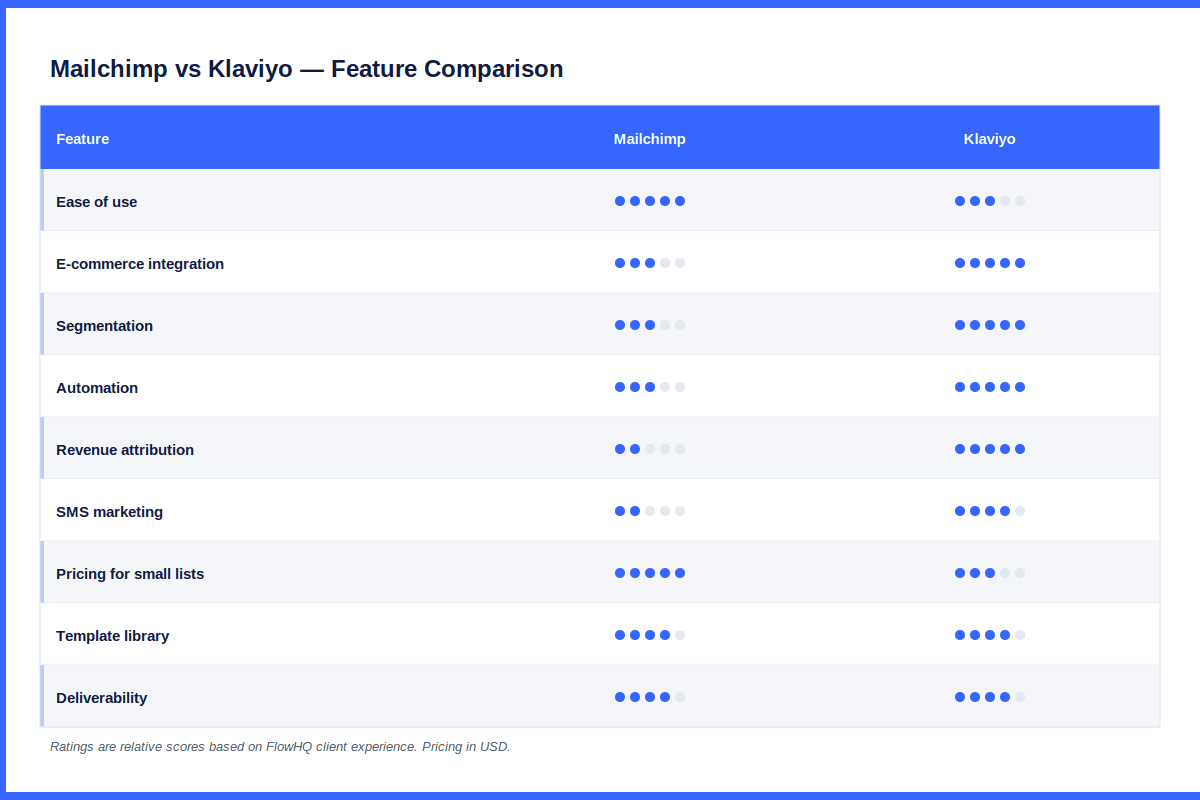
Mailchimp vs Klaviyo: feature comparison
Pricing: what you'll actually pay
Pricing figures are in USD.
Mailchimp:
- Free: up to 500 contacts, 1,000 sends/month.
- Essentials: from ~$13/month (500 contacts).
- Standard: from ~$20/month (500 contacts).
- Premium: from ~$350/month (10,000 contacts).
Klaviyo:
- Free: up to 250 contacts, 500 sends/month.
- Paid plans start from ~$45/month (1,001–1,500 contacts).
- 10,000 contacts: ~$150/month.
- 50,000 contacts: ~$700/month.
The pricing gap widens significantly at scale. For a business with a large list that isn't doing sophisticated e-commerce automation, Mailchimp will almost always be the more cost-effective choice.
Which businesses should choose Mailchimp?
- Service businesses — consultants, agencies, coaches, tradespeople who need reliable email campaigns and a simple CRM-like contact database.
- Non-profits — Mailchimp offers significant discounts for non-profits and the feature set suits typical non-profit communication needs.
- Early-stage e-commerce — businesses just starting out that need basic abandoned cart emails and welcome flows without a significant platform investment.
- Content creators and bloggers — newsletter-first businesses where the email itself is the product.
- Businesses with limited technical resources — where email is one of many jobs on one person's plate and ease of use outweighs depth of capability.
Which businesses should choose Klaviyo?
- Established DTC brands — e-commerce businesses with meaningful transaction volume, a connected Shopify or WooCommerce store, and a desire to drive revenue through email.
- Businesses investing in personalisation — where the goal is to send fewer, better-targeted messages based on what customers actually do rather than who they are.
- High-frequency senders — businesses sending multiple campaigns per week where deliverability and list hygiene tools matter.
- Brands with SMS ambitions — Klaviyo's combined email and SMS platform makes it a strong choice for businesses wanting both channels in one place.
- Businesses with revenue attribution goals — if you want to know exactly what your email programme contributes to the bottom line, Klaviyo's attribution is hard to beat.
The platform you may not have heard of: Transpond
If you want a great mix of simplicity and advanced features — at a lower price than Mailchimp — Transpond deserves a spot on your shortlist.
Built by the same team behind Capsule CRM, Transpond is more than just an email tool. It includes drag-and-drop campaign building, marketing automation, social posting, AI-assisted content, and a shared conversations inbox. For Capsule CRM users it's a natural fit — contacts, tags, and campaign data sync natively with no third-party connector required.
But even for businesses not on Capsule, Transpond is worth considering. It offers more capability than Mailchimp at a more accessible price point, with a clean interface that doesn't require technical expertise to use well.
Transpond is worth considering if:
- You're already on Capsule CRM and want everything connected natively.
- You want more features than Mailchimp without paying Klaviyo prices.
- You run a small business without a dedicated marketing person.
- You want email, automation, and social posting in one tool.
Learn more about Transpond and how FlowHQ uses it →
What about switching later?
One question we hear constantly: can I start on Mailchimp and move to Klaviyo later?
Yes — and many businesses do. But migration has a cost. You'll need to:
- Export and clean your contact list.
- Rebuild your automation flows from scratch in Klaviyo.
- Recreate your templates.
- Re-establish your sending domain reputation.
- Retrain whoever runs your email programme.
None of this is insurmountable, and FlowHQ helps businesses make this switch regularly. But it's worth getting the decision right the first time if you can — migration is a project, not a button click.
The verdict
Mailchimp and Klaviyo are both excellent platforms for the businesses they're designed to serve. The mistake is choosing based on price alone, or on what your competitors use, or on the most recent review you read.
The right question is: what job do you need your email platform to do?
If the answer is reliable, professional email marketing that your team can run without specialist knowledge — Mailchimp.
If the answer is e-commerce lifecycle marketing tied directly to purchase behaviour and revenue — Klaviyo.
If you're not sure which camp you fall into, or you're somewhere in between, that's exactly the conversation FlowHQ is built for. We help businesses work out what they actually need — and build the stack that delivers it.
FlowHQ works with Klaviyo, Mailchimp, HubSpot, Segment, Shopify and more. Get in touch if you'd like to talk through which platform is right for your business.
More Articles For You To Read
Email Marketing Benchmarks 2026: What Good Actually Looks Like
Are your email numbers good? It depends on your industry, your send frequency, and what you're measuring. Here's what the benchmarks actually look like in 2026 — and what moves them.
Continue Reading
CRM Comparison 2026: What to Look for When You’re Scaling Fast
Growth exposes every weakness in your tools. Here's a practical framework for choosing the right CRM at each stage of your business — and avoiding the migration you'd rather not do twice.
Continue Reading